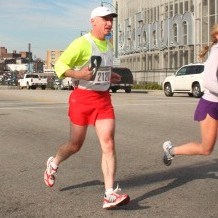
Six easy miles on the treadmill. It's still icy outside and the forecast is for freezing fog tonight, so tomorrow may be no picnic on the streets and highways either. Six of my 19 patients today actually showed up; only a couple of the others actually bothered to call and cancel. Perhaps they thought we would be closed like most of the doctors' offices in town. I've now run 27 miles in 10 days since the 26.2 in one day. It's still hard for me to think of myself as not only a multiple marathoner, but a successful (relatively speaking), goal-achieving marathoner. My athletic career, such as it was, tended to consist of bumping up very quickly against limits I could not overcome. Too small and not strong enough for football, too short and not quick enough for basketball, inadequate hand-eye coordination for baseball and golf, not enough training to do the job in track.One problem I think I had is that I didn't know what it took to succeed as an athlete. I didn't have the concept of hard work as a vital component; why my dad, who was an all-America high school football player and a Division I recruit, didn't try to impart that to me, I still don't know. I didn't lift enough weights and do enough drills to overcome my small size in football, I didn't develop other skills like ballhandling to compensate in basketball, and I didn't build my base enough to become more than a mediocre middle-distance runner in track. I probably would have done the same as a marathon-wannabe if I hadn't found good resources like Pfitz' book, and this blog, and the RWOL forums. There, I found out what other people who were succeeding did, and not only that, I got encouragement that I never got from my coaches as a kid. I never showed enough natural talent for them to really bother coaching me, and they spent their time coaching the kids who had the talent. But with all the help I got, nobody ran a single step for me. I had to push myself out the door six times a week, and put in the miles whether I felt good or not, do the LT runs and the MP runs and the VO2-max semisprints and run the hills, and make the effort to read the books and the forums and apply what I read there to my own situation. Much of it helped, some of it didn't, and I had to decide what applied to me and what didn't. So now I'm in uncharted territory for me. I've achieved two major athletic goals -- running a marathon, and breaking four hours. I'm now a better-than-average marathoner (in 2007, the average male finisher in an American marathon ran a 4:29:52, according to marathonguide.com, and only 15% broke 3:30; I'm a lot closer to 3:30 than 4:30 now. The average for my age group was 4:24:40). But now I've got to press on and see what else is in there. BQ, 3:15, 3:00 -- what is my limit at age 48-plus, and how can I get there? I ran a 5:05 mile and 11:02 two-mile in high school; how much of that speed is still there? Can I learn to run 26.2 at 7:24 pace? How about 6:51? Right now I haven't even run a 5K at 6:51, although I think I could do that now much better than I could last July. Is BQ going to be enough for me? Is 3:15 enough? Will my wife let me find out? Back to the icy weather: my TV-reporter friend Michelle, fresh off her first sub-five marathon, was doing a live remote tonight standing near an ice-clogged stretch of freeway. She was wearing a blue Brooks jacket and earmuffs. I cracked up when I saw her; I've seen those exact earmuffs and jacket at 6 a.m. on a Crackhead run. But her hair and makeup were a lot nicer than they are at 6 a.m. :) (I know you sometimes read the blog, Michelle; that's why I'm picking on you). |