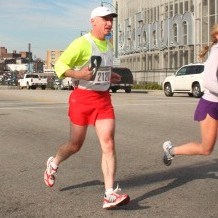
Taking the night off in favor of early bedtime after a poor night's sleep last night, but will do some further ruminating here.
Big debate on RWOL about Boston 2010 filling up early and what if anything should be done about it. The marathoning snobs tend to push for tougher standards, which makes no sense to me. If there are 40,000 qualifying times in the US each year, but only 20,000 people get into Boston, that tells me that the standards are not a big issue here; there are plenty of people whose times are well below BQ minimums that aren't running. Others want a bigger field, which makes more sense if the logistics are there. My sense, not having run in Boston yet but having read reports and seen the streets in Hopkinton and Ashland firsthand, is that there's not really any place to put extra runners.
Jim Fortner, known on RWOL as Jim2, has done a lot of research on BQ, using data culled from MarathonGuide.com over a three-year period in more than 200 American marathons run on USATF-certified courses with more than 100 finishers. His figures are that in those races, about 10.7% of all finishing times meet BQ standards. However, he does not include people like me, who are still in one age group but have run a qualifying time for the next age group. He thinks this factor may increase the number of qualifiers by 10-20% in certain age groups. But even at that, you're talking 11-12% of all finishes meeting the BAA standards.
Eleven or 12 percent. Not many, and because some fortunate/talented people run multiple BQ times each year, actually may overstate how many people are fast enough to get in. That's why Boston is such a prize to marathoners -- because it's hard to get there. It may have been SLIGHTLY easier for me as a 49-year-old than it would have been as a 30-year-old, but it's still hard. Jim2's research shows that Memphis from 2006-2008 averaged a 14.5% BQ rate for male finishers -- better than many, but still only one out of seven finishers. This year, only 11.2%. Newport's men averaged 26.5% (but that was with the old, unintentionally short course; with the new, 26.2 mile course in 2009, it was 25.4% -- and I was in the other 74.6%). Also, in 2008, 15% of men's finishes in the 45-49 bracket (mine) were fast enough to get in, the highest percentage of any age group below age 65, which undoubtedly reflects that 10-minute jump from the 40-44 qualifying time to the 45-49 time. The 50-54 group, where I will be running in 2011, has a rate of 13.4%.
So, by various BQ-related measurements, I am now in the top quintile of American male marathoners, perhaps higher. I guess what prompted this topic was an old article from Running Times I came across last night. It followed three decent marathoners as they worked to qualify for Boston in, I think, 2006. All three trained very diligently, but only one of the three qualified for Boston. And, in a pre-publication update, although the other two made further progress, neither one had reached their goal. I trained diligently, also had my missteps as the two nonqualifiers in the RT article did, but I got there. |